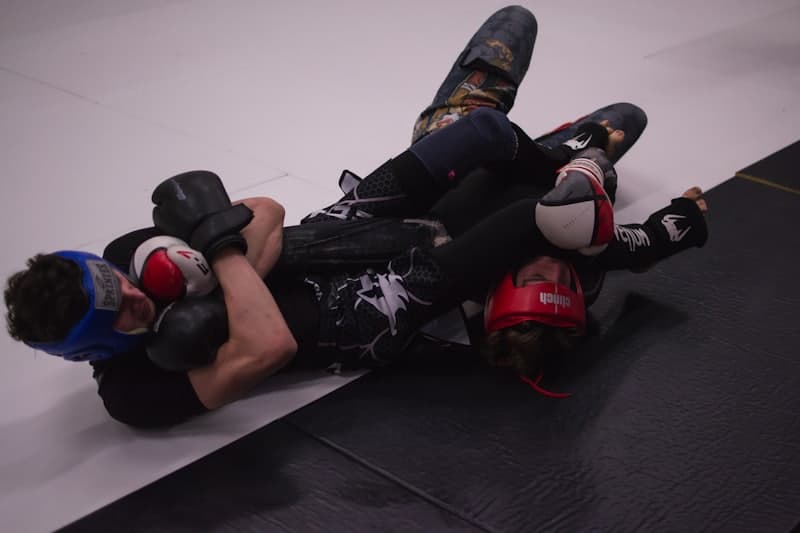
A BJJ strength and conditioning program has to serve a sport that lives in isometric holds and sudden bursts, not steady output. Grapplers who train like bodybuilders build muscle they can't apply under a grip fight three minutes into a roll. Grapplers who only run build an engine with nothing to hold a frame with when it matters. Strength training for Brazilian Jiu-Jitsu needs both qualities built in the right order, and it needs to hold up whether your next match runs five minutes or ten.
That is what this program is built to do. It periodizes strength and conditioning backward from your competition date, using the same conjugate method and energy-system conditioning that structures every camp this engine builds, adapted specifically to what Brazilian Jiu-Jitsu asks of a body: relentless grip endurance, pulling-dominant strength, and a lactic system that has to fire again and again through a scramble.
Everything below describes how the program reasons about a grappler's body. The app turns it into your exact sessions, week by week, from now until your competition.
What BJJ demands from your body
Spend time on the mats and the pattern becomes obvious: Brazilian Jiu-Jitsu rewards the athlete who can hold a position under pressure as much as the athlete who can move fast. Long isometric holds, sudden bursts to escape or finish, and grips that have to stay locked on for minutes at a time all sit outside what a conventional strength program trains for. A strength and conditioning program built for grappling has to train the hold, not just the movement.
Grip is the currency of Brazilian Jiu-Jitsu. Collar grips, sleeve grips, pummeling for underhooks, fighting a frame off your hips, all of it is a grip and forearm endurance contest layered on top of the technical game. A grappler who loses the grip battle loses access to the rest of their game long before a submission is ever threatened.
That grip fight rarely lets up for the length of a match, which is part of why grapplers who train grip only as an accessory movement, a few sets tacked onto the end of a session, get outlasted by opponents who have trained it as a primary quality.
Underneath the grip demand is a pulling-dominant strength profile. Guard retention, closing distance, finishing a takedown, and controlling a back are all pulling patterns, not pushing ones, and a program built around generic pushing strength misses what the sport actually rewards. Isometric strength matters just as much as dynamic strength here: holding a frame, holding side control, holding a grip under pressure for long stretches without the joint ever moving through a full range.
Conditioning has to answer to the scramble, the short, explosive, lactic-heavy burst that decides a transition, layered on top of a match that can run anywhere from five to ten minutes depending on the ruleset and division. A program tuned only for a five-minute white-belt match leaves a ten-minute black-belt match unanswered, and a program tuned only for steady-state output leaves the scramble unanswered. This program builds both.
These qualities compound on each other. A grappler with strong isometric grip but no scramble conditioning holds a position early in the match and loses it late, once the lactic system runs dry. A grappler with a big gas tank but a weak grip never gets to hold the position in the first place. The program treats grip endurance, pulling strength, and lactic capacity as one connected system, because that is how a live roll actually plays out.
Strength training for Brazilian Jiu-Jitsu: the conjugate method
Strength work runs on two days a week using the conjugate method: a Max Effort day and a Dynamic Effort day. Max Effort work is heavy, low-rep effort in the 1 to 3 rep range on a lift that rotates on a schedule, so the body never fully adapts to a single movement and stalls. For a grappling strength program, that rotation leans into pulling patterns and grip-intensive variations, directly training the strength qualities a guard pass or a mat return actually calls on.
Dynamic Effort day trains speed under load: lighter weight moved as fast as possible at prescribed percentages, with bands and chains added as the camp progresses to keep the movement explosive under increasing tension. Both strength days carry an explosive block, jumps and throws matched to grappling's movement patterns and rotated every wave, plus accessory work: higher-rep pulling, grip, and weak-point training whose volume is set by where you sit in the camp. Grip-intensive accessory work in particular gets treated as its own priority rather than an afterthought tacked onto a pulling day, because grip endurance failing under fatigue is one of the most common ways a technically sound grappler loses position.
ME and DE run in three-week waves, with intensity climbing across the wave before it resets onto new lifts. In the final stretch of the camp, training shifts to full-body contrast work: a heavy lift immediately followed by an explosive movement, while the nervous system is still primed. That is how weeks of grip and pulling strength convert into power you can actually access in a live roll.
The rotation matters as much as the effort. A grappler who repeats the same pull week after week eventually stalls, not because the lift is wrong but because the body stops responding to a stimulus it has fully adapted to. Rotating the Max Effort lift on a schedule, while keeping the underlying pulling and grip-intensive pattern, keeps the strength climbing without ever drifting away from what grappling actually needs.
BJJ conditioning: training grip endurance and lactic capacity on purpose
Conditioning runs three days a week, and BJJ conditioning has a particular problem to solve: lactic and aerobic adaptations conflict with each other, so you cannot maximally build both at once. The program sequences them in blocks instead of blending them, aiming first at the endurance base that supports everything else, then shifting toward the explosive, high-output qualities a scramble demands as the camp progresses.
Where you start depends on your conditioning level on day one. Coming off a layoff, the program leads with aerobic base and local muscular endurance work; already in competition shape, it can move faster into explosive conditioning methods. The block transitions are gradual, with the next block's methods showing up at low volume before the switch, not a sudden change in direction.
The methods themselves are named in the program as Cardiac Power Intervals, Explosive Repeat work, and Tempo Method sessions, alongside direct lactic capacity work built for scramble-to-scramble output. Explosive Repeat carries a built-in weekly progression, more work and less rest as the weeks pass, so the demand increases on its own schedule. Every conditioning session runs in grappling-specific context, not generic intervals, because the sport determines what the drill looks like, not just which energy system it targets.
This sequencing protects a grappler across a full competition cycle. Training every quality at maximum volume all year is how athletes show up to a tournament with a body that has nothing left to give. Building the endurance base first, then shifting into higher-output conditioning as the competition approaches, means peak output lands on the day it needs to, not in the middle of a random training block.
The camp: 8 to 12 weeks, backward from fight night
The full camp is periodized backward from your competition date. Extra weeks in a longer camp extend the base-building phase only; the sharpening and taper weeks at the end stay fixed. An 8-week camp runs 3 weeks of base building, 3 weeks of cardiac power work, 1 taper week, and 1 fight week. A 10-week camp extends the base to 5 weeks. A 12-week camp extends it to 7. The final two phases never change length.
The taper week drops volume and sharpens intensity to match your competition pace. Fight week is a clean break: no new adaptation work, no overlap with the block before it, just enough movement to stay sharp while you recover fully. For the complete phase-by-phase breakdown, see How to Structure a Fight Camp.
A week inside the camp
A typical week carries two strength days and three conditioning days. Strength days sit early in the week: Max Effort first, built around a rotating pull or grip-intensive lift, then Dynamic Effort a few days later, speed work under band or chain tension. Both carry an explosive block and accessory work, timed around your mat schedule instead of competing with it.
Conditioning days are spread across the week in whatever block the camp currently sits in, aerobic base work early on, cardiac power intervals and lactic capacity work as the camp progresses, all run in a grappling context. Earlier in the camp that might mean longer, steadier work alongside grip and isometric accessory training; closer to competition it shifts to shorter, harder scramble-paced conditioning with full recovery built in so the strength days stay sharp.
Nothing on the calendar is a guess. Every session is generated from your competition date, your goals, your experience level, and the equipment you have access to. The program does not hand you a menu of set and rep options; it prescribes exactly what the week calls for, so your energy goes into the training itself instead of into programming decisions. See the full engine on the features page, or check pricing to build your camp.
Common questions
How many days a week is a BJJ strength and conditioning program?
Five sessions: two strength days and three conditioning days, structured around your mat schedule for the week.
Do I need a full gym for strength training for Brazilian Jiu-Jitsu?
No. The program adapts exercise selection to the equipment you have available, from a full barbell setup down to bodyweight and bands, without changing the structure underneath it.
How long before a competition should I start a BJJ conditioning program?
Camps run 8 to 12 weeks, periodized backward from your competition date. Longer camps extend the base-building phase; the final sharpening weeks and the taper stay fixed.
Does this replace mat time or technique training?
No. This is strength and conditioning only, run alongside your Brazilian Jiu-Jitsu training with your coach. The program does not advise on technique, weight management, or nutrition.
Your camp, prescribed
Fight Werx builds your full 8–12 week camp from your fight date, your sport, and your goals. Every session prescribed. Nothing left to guess.
Build my camp7-day free trial · Cancel anytime
Keep reading
MMA Strength & Conditioning Program
Build the explosive power and late-round gas an MMA camp demands, prescribed week by week.
Boxing Strength & Conditioning Program
Train rotational power and repeated hand speed on a strength and conditioning camp built for boxers.
Muay Thai Strength & Conditioning Program
Develop hip-driven kicking power and clinch strength across an 8 to 12 week Muay Thai training program.
Wrestling Strength & Conditioning Program
Prescribe the grip strength, explosive hips, and lactic capacity a wrestling season demands.
How to Structure a Fight Camp
See how an 8 to 12 week fight camp is periodized backward from fight night, phase by phase.