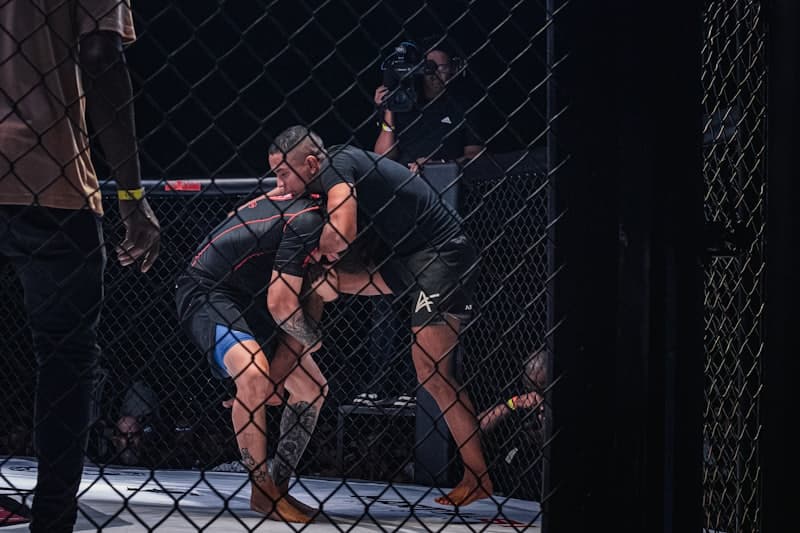
An MMA strength and conditioning program has to answer for two completely different fighters living in the same body. One of them needs to explode into a takedown or land a fight-ending combination in half a second. The other needs to still be moving with the same sharpness in the fifth round, after three rounds of grappling exchanges and striking volume that would leave most athletes gassed by round two. Most gym programming picks one of those fighters and ignores the other.
Bodybuilding splits build muscle that never gets used explosively. Pure roadwork and long runs build an aerobic engine but sand off the power that ends fights early. A camp built for MMA has to train strength, power, and every energy system your fight actually calls on, in the same eight to twelve weeks, without one adaptation eating the other.
That is what a purpose-built MMA strength and conditioning program does: it prescribes exactly what your body needs, in the order your body needs it, counting backward from the day you step in the cage.
The engine behind that program is built on conjugate periodization, the same strength methodology that has produced explosive combat athletes for decades, paired with energy-system conditioning that respects how the body actually adapts. Put together, they answer the question every MMA fighter eventually asks: how do you get stronger and more explosive while also building the gas tank to use it for three to five rounds. This guide walks through exactly how.
What MMA demands from your body
MMA is the most physically demanding combat sport to program for because it refuses to specialize. A single fight can include an explosive shot on the legs, a scramble back to the feet, a flurry of strikes, and a clinch battle against the cage, all inside sixty seconds. The strength qualities that finish a takedown are not the same qualities that let you throw a clean combination while fatigued, and neither of those is the same as the aerobic capacity that lets you recover between exchanges instead of breathing through your mouth for the rest of the round.
Practically, that means an MMA camp has to develop grappling strength and striking power at the same time, then layer conditioning on top that lets you access both qualities late into a fight. Most fighters walk into a gym and either lift like a bodybuilder, chasing muscle that never transfers to the cage, or skip strength work entirely and run themselves into the ground trying to build a gas tank through mileage alone. Neither approach prepares you for what a fight actually asks of you: explosive output, repeated, under fatigue, for up to twenty-five minutes.
Common goals for MMA athletes fall into a few clear buckets: knockout power for fighters who want their hands to end fights early, takedown drive for fighters who win exchanges by controlling where the fight happens, and late-round gas for fighters who know their best output shows up in the third round when opponents start fading. A generic program cannot prioritize all three at once. A prescriptive one reads your goals and your sport and builds a camp that actually targets them, instead of handing every fighter the same generic split and hoping something transfers.
MMA strength training: the conjugate method
Fight Werx builds MMA strength training on the conjugate method, rotating training stress so you develop maximal strength and speed strength in parallel instead of chasing one at the expense of the other. Two strength days a week carry the load.
Max Effort day works heavy, low-rep strength, typically in the one to three rep range, on a lift that rotates on a set schedule. That rotation matters: grinding the same heavy lift week after week is how strength gains stall out. A new lift variation every wave keeps your nervous system adapting instead of grinding along a plateau. Dynamic Effort day trains speed, not size: lighter loads moved as fast as possible at prescribed percentages, with bands or chains layered in as the camp progresses to keep bar speed the priority all the way through the lift.
Both strength days carry an explosive block matched to MMA’s movement patterns, jumps and throws that mirror the hip extension of a takedown or the rotational snap of a strike, rotated every wave so the same two or three exercises never go stale. Accessory work fills in behind that: higher-rep work targeting the weak points that limit your main lifts, with volume that shifts as the camp phase changes.
ME and DE lifts run in three-week waves. Intensity climbs across each wave as you adapt to the lift, then the wave resets with new exercise selections before staleness sets in. In the final stretch of the camp, strength training shifts into full-body contrast work: a heavy lift immediately followed by an explosive movement, so your nervous system is primed to express that strength as speed. That is how the program peaks your power output for fight week instead of just your one-rep max.
None of this is left for you to figure out on your own. You will never open the app and see a menu of lifts to pick from. The program tells you the exact lift, the exact intensity, and the exact explosive pairing for that session, based on your sport, your goals, your equipment, and the week of the camp you are in. That is the entire point: a fight camp is not the time to be guessing at programming decisions between rounds of sparring.
MMA conditioning workout: energy systems built in order
The conditioning side of an MMA conditioning workout is where most gym programming falls apart, because lactic and aerobic adaptations pull against each other. You cannot maximally develop both at once, so the program has to choose which one gets priority at each point in the camp, and that choice depends on where your conditioning actually starts.
If your conditioning is behind on day one, the camp opens aerobic-heavy, building the base that every later phase depends on. If you walk in already conditioned, the program can lead with explosive conditioning methods sooner. Either way, three conditioning days a week carry named methods you will recognize once you are in the app: Cardiac Power Intervals for building heart power and VO2max, Explosive Repeat work that layers built-in weekly progressions of its own, and tempo-based strength conditioning that uses compound movements at a controlled cadence rather than a stopwatch-driven circuit.
The block that follows aerobic base work targets heart power and reduces central fatigue, and the block after that sharpens fight-specific intensity and work rate. Every method uses MMA movement patterns, not generic cardio, so the conditioning you build in the gym shows up on the mats.
Equipment matters here too. MMA athletes train in everything from full performance gyms to a mat room with a single heavy bag. The engine takes your equipment as an input and adapts your strength and explosive work around it, and the conditioning methods are built on work and rest structures you can hold anywhere: rounds on the bag, drilling at prescribed intensity, or a stopwatch and a jump rope.
The camp: 8 to 12 weeks, backward from fight night
Every camp is periodized backward from your fight date. The math behind the phases is fixed: extra camp weeks extend the base phase only. The taper and fight week never move, no matter how long your camp runs.
An 8 week camp runs 3 weeks of base training, 3 weeks of cardiac power development, a 1 week peak and taper, and a 1 week fight week. A 10 week camp stretches the base phase to 5 weeks. A 12 week camp stretches it to 7. In every case, the final 5 weeks look the same: 3 weeks of cardiac power work, a 1 week taper, and a 1 week fight week that holds your adaptations instead of chasing new ones.
Fight week is a clean break from everything before it: no overlap with prior training blocks, no high-intensity work, maintenance only. For the full breakdown of how phases transition, why base training only ever gets longer, and what changes wave to wave inside each block, see the complete guide to structuring a fight camp.
A week inside the camp
A typical week in an MMA fight camp training program carries five prescribed sessions: two strength days and three conditioning days, spaced around whatever skill and sparring schedule your gym runs. Strength days open the week, giving your nervous system time to recover before high-intensity skill work. Conditioning days are placed to build your engine without leaving you too fatigued to train technique with the sharpness a fight camp requires.
Nothing about the split is left to guesswork. The lift on Max Effort day, the percentage on Dynamic Effort day, the conditioning method and its target output for that session, all of it is set by the phase you are in and the week you are on. As the camp moves from base to cardiac power to peak, the balance of the week shifts with it, always pointed at the same fight date you started with.
As the fight approaches, session length and volume come down even as intensity holds or climbs, so your body is absorbing the work instead of just accumulating fatigue. By the time fight week arrives, the only job left is to maintain what the previous seven to eleven weeks already built. Nutrition, weight management, and technical preparation stay with your coach and your corner. This program’s job stops at strength and conditioning, and it does that one job completely.
That focus is deliberate. A fighter juggling ten decisions about sets, reps, and conditioning intervals on top of skill training, weight management, and fight preparation is a fighter who eventually drops one of those balls. Removing the programming decision entirely, and replacing it with a prescription built specifically for your sport, your goals, and your fight date, is what lets you spend your limited energy on the parts of camp that actually need your judgment.
You can see the engine that builds every one of these sessions on the features page, and get the full breakdown of what is included in each tier on pricing.
Common questions
How many days a week does an MMA strength and conditioning program take?
Five training days: two strength sessions and three conditioning sessions, built around your skill and sparring schedule rather than competing with it.
Do I need a full gym for an MMA strength and conditioning program?
No. The engine takes your equipment as an input and adapts the strength and explosive work to what you have, from a full barbell setup to a garage with kettlebells.
How long before my fight should I start the camp?
Camps run 8 to 12 weeks, periodized backward from your fight date. Shorter camps compress the base phase; longer camps extend it, never the taper.
Does this replace my MMA skill training?
No. This runs alongside striking, wrestling, and grappling work. The app handles strength and conditioning only, so your coach and your training partners handle everything technical.
Your camp, prescribed
Fight Werx builds your full 8–12 week camp from your fight date, your sport, and your goals. Every session prescribed. Nothing left to guess.
Build my camp7-day free trial · Cancel anytime
Keep reading
Boxing Strength & Conditioning Program
Train rotational power and repeated hand speed on a strength and conditioning camp built for boxers.
Muay Thai Strength & Conditioning Program
Develop hip-driven kicking power and clinch strength across an 8 to 12 week Muay Thai training program.
Wrestling Strength & Conditioning Program
Prescribe the grip strength, explosive hips, and lactic capacity a wrestling season demands.
BJJ Strength & Conditioning Program
Build grip endurance, pulling strength, and scramble conditioning for Brazilian Jiu-Jitsu competition.
How to Structure a Fight Camp
See how an 8 to 12 week fight camp is periodized backward from fight night, phase by phase.