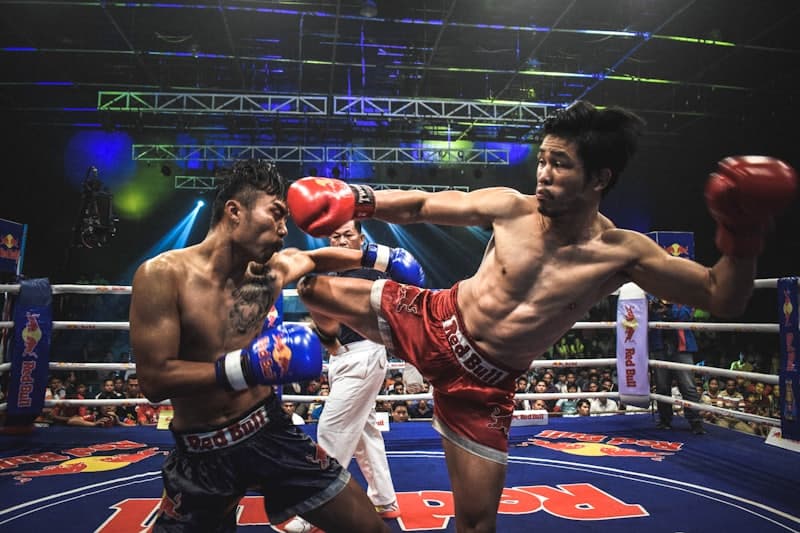
A Muay Thai strength and conditioning program has to answer to a different body than boxing or wrestling. The power in a kick comes from the hip, not the leg swinging loose at the end of it. The clinch turns a fight into a grip-and-drag contest for long stretches of a round. And a bout is fought in three to five rounds of sustained output, not short alactic bursts with long rests between them. A program built for a different sport, or no program at all beyond bag rounds and roadwork, leaves those specific demands untrained.
Most Muay Thai fighters lift like bodybuilders, chase soreness instead of hip power, or skip the weight room entirely and try to build fight fitness purely through pad rounds and running. Both approaches leave gaps: a bodybuilding split does nothing for elastic hip extension, and pad rounds alone will not build the isometric grip endurance a two-minute clinch battle demands. A real Muay Thai training program has to be built around what the sport specifically asks of the body.
Fight Werx builds that program automatically. Enter your fight date, experience level, and available equipment, and the engine periodizes an 8 to 12 week camp designed around Muay Thai's actual physical demands, not a generic fight camp template with the name changed.
What Muay Thai demands from your body
A Thai kick is an elastic, hip-dominant movement. The leg is closer to a whip than a lever, and the power comes from rapid hip rotation and extension, not from muscling the shin into the target. A fighter who trains only linear strength, squats and presses with no rotational or elastic component, will have a kick that looks technically sound but lacks snap, because the tissue and the nervous system were never trained to produce force that fast in that pattern.
The clinch is a different problem entirely. Controlling a plum, fighting for underhooks, and dragging an opponent off balance all demand grip strength and pulling strength, but not in the explosive, one-rep sense. Clinch strength is largely isometric: holding a position under load, fighting for control for seconds at a time, over and over across a round. That kind of strength endurance does not show up from heavy pulling alone; it has to be trained as its own quality.
Knees and elbows add a short-range power component on top of the kicking and clinch demands, close-quarters strikes that still rely on hip drive and torso rotation even with a shortened lever arm. And all of it has to be sustained across three to five rounds of continuous output, longer and more relentless than a boxing round's stop-start combinations. That combination, elastic power plus isometric strength plus sustained round output, is specific to Muay Thai, and a training program has to be built around all three at once.
Muay Thai strength training: the conjugate method
Fight Werx trains Muay Thai strength with the conjugate method: a Max Effort day and a Dynamic Effort day each week, each carrying an explosive block and accessory work.
Max Effort day builds the strength foundation everything else depends on, heavy work in the one to three rep range with the specific lift rotating on a schedule so the body keeps adapting instead of stalling on the same movement camp after camp. A stronger hip hinge and a stronger posterior chain both translate directly into more force available to put behind a kick.
Dynamic Effort day trains the nervous system to move load fast, speed work at prescribed percentages with bands and chains added as the camp progresses. This is where explosive hip extension gets built in the weight room, the same neural pattern a kick relies on, just loaded and made measurable.
The explosive block in every session uses jumps and throws matched to Muay Thai's hip-dominant, rotational movement pattern, rotated wave to wave so the same two exercises never overstay their welcome. This is where elastic kicking power gets trained directly rather than hoped for as a side effect of heavy lifting. Accessory work fills in weak points, including the grip and pulling strength the clinch demands, at a volume that shifts with camp phase.
ME and DE both run in 3-week waves, intensity climbing across the wave before the lifts reset. In the final stretch before the fight, the program shifts to full-body contrast training, a heavy lift immediately followed by an explosive movement while the nervous system is primed, converting the camp's accumulated strength into the kind of power that shows up in a fight.
Muay Thai conditioning exercises: building output across five rounds
Conditioning is built on energy systems science and starts from where you actually are: a fighter with a poor aerobic base begins with more aerobic- heavy work to build the foundation everything else sits on, while a fighter with an already-strong base can move into explosive conditioning methods sooner.
From there the camp progresses through blocks. Early work builds local muscular endurance and the clinch-specific isometric endurance a fighter needs to hold position without gassing, alongside the general aerobic base. Later blocks shift toward heart power and VO2max development, the physiology that lets a fighter's output in round four look like their output in round one instead of falling off a cliff. Block transitions overlap gradually rather than switching all at once, with the next block's methods appearing at low volume before the full changeover.
The methods themselves show up in Muay Thai-specific context: Cardiac Power Intervals and Explosive Repeat work built around kicks, knees, and clinch exchanges rather than generic intervals, plus lactic capacity work for the extended grinding that clinch battles and hard rounds demand. The clinch itself is an isometric battle for underhooks and control, and the local muscular endurance built in the base phase, alongside the grip and pulling strength on the accessory side, is what answers it. The exercise context stays Muay Thai throughout: kicking combinations, knee and elbow drills, and clinch-specific movement, not borrowed drills from a different sport wearing different gloves.
The camp: 8 to 12 weeks, backward from fight night
Every camp is periodized backward from your fight date, with a fixed structure where extra weeks only extend the first phase. Stage 1, Base and Power, builds the aerobic foundation, local muscular endurance, and early explosive power; it runs 3 weeks in an 8-week camp, 5 weeks in a 10-week camp, and 7 weeks in a 12-week camp. Stage 2, Cardiac Power, holds at a fixed 3 weeks regardless of total camp length, shifting focus to heart power and VO2max. Peak and Taper is a fixed 1 week of fight-specific intensity as volume drops. Fight Week is a fixed 1 week that maintains what has been built, with no new intense work, a clean break rather than a slow fade.
For the complete phase-by-phase, wave-by-wave breakdown of how that backward planning works, see How to Structure a Fight Camp.
A week inside the camp
Each training week holds two strength days and three conditioning days. The Max Effort day carries a heavy lift on that week's rotation, an explosive block of hip-dominant jumps or throws, and accessory work that includes clinch-relevant grip and pulling strength. The Dynamic Effort day carries speed work at a prescribed percentage, its own explosive block, and accessories set by the current phase.
The three conditioning days train the specific demands of a Muay Thai round. Depending on where the camp sits in its block progression, a week might include a Cardiac Power Interval session built around kick and knee combinations, lactic capacity work for the clinch grind, and a longer aerobic session protecting the base underneath everything else. Every session is prescribed exactly, nothing left to sort through, so the only decision left is showing up and doing the work in front of you.
See the full system on the features page, including logging and per-exercise history once your camp starts. Ready to begin? Pricing covers both the Athlete and Gym tiers.
The strength work and the conditioning work are not running on separate tracks. Hip power built on Dynamic Effort day is the same quality a fighter needs fresh in round four, and clinch-endurance conditioning is training the same isometric grip strength the accessory work is building in the weight room. A camp that only lifts produces a fighter with strong kicks in the first round and nothing left for the clinch by the third. A camp that only runs pad rounds and skips the weight room produces a fighter with a big engine and no snap on the kick that is supposed to end the fight. Muay Thai punishes that gap more than most sports because so much of the fight happens at close range, where strength endurance decides who controls the exchange.
In the final week before the fight, strength and conditioning taper together. Lifts stay intense but drop in volume, and conditioning shifts from building capacity to sharpening what is already there, protecting the adaptations from camp instead of chasing new ones this close to fight night. That coordinated taper is what makes Fight Week a clean break rather than a gradual fade: the work that mattered is already done.
Common questions
How many days a week is the Muay Thai training program?
Five. Two strength days and three conditioning days, built to sit alongside your pad work and clinch sessions rather than compete with them.
Do I need a full gym for Muay Thai strength training?
No. The engine reads your available equipment and adapts exercise selection to what you actually have, from a full strength room down to bodyweight and bands.
How long before my fight should I start?
Eight to twelve weeks out. That gives a camp enough time to build the aerobic base, develop hip power and clinch strength, sharpen fight-specific conditioning, and taper properly before fight night.
Does this replace my Muay Thai training?
No. Pad work, clinch technique, and sparring stay with your coach. This program builds the strength and conditioning underneath that training so your hips, grip, and engine can hold up to camp.
Your camp, prescribed
Fight Werx builds your full 8–12 week camp from your fight date, your sport, and your goals. Every session prescribed. Nothing left to guess.
Build my camp7-day free trial · Cancel anytime
Keep reading
MMA Strength & Conditioning Program
Build the explosive power and late-round gas an MMA camp demands, prescribed week by week.
Boxing Strength & Conditioning Program
Train rotational power and repeated hand speed on a strength and conditioning camp built for boxers.
Wrestling Strength & Conditioning Program
Prescribe the grip strength, explosive hips, and lactic capacity a wrestling season demands.
BJJ Strength & Conditioning Program
Build grip endurance, pulling strength, and scramble conditioning for Brazilian Jiu-Jitsu competition.
How to Structure a Fight Camp
See how an 8 to 12 week fight camp is periodized backward from fight night, phase by phase.